
AI tools for astrology in India: kundli, horoscope and panchang apps
Published , Updated , 19 min read
If you want an AI astrology tool in India, start with two free options: AstroSage Kundli AI for a full Vedic kundli, panchang and kundli matching, and Melooha or KundliGPT for asking one personal question to an AI astrologer without paying first. All three work in India without a VPN, and none of them forces you to pay before you can see a basic chart or ask a first question. Everything else in this article is for a specific need — a Western birth chart, a tarot-style daily reading, or learning what a placement in your chart actually means — and each paid wall is named honestly below.
Before anything else, the honest frame for this whole article: astrology is a belief system and a form of entertainment, not science. Scientific studies that have tested astrological claims have not found evidence supporting them, and a chart calculation being astronomically correct is not the same thing as a prediction about your life being correct. The planet positions in a kundli can be calculated precisely; what those positions mean for your career, marriage, health or money is interpretation, tradition and belief — not a proven fact. So enjoy a reading, use it for reflection or conversation if you like, but do not let it decide a marriage, a medical choice, an investment, a job change or any other major life decision. This article is general information only, not professional advice of any kind, and for health, money or legal decisions you should check official sources and qualified professionals, not an app.
That distinction also explains what AI actually adds here. AI does not make astrology scientific. What it does is speed up the boring parts: calculating planetary positions from your birth date, time and place, drawing the chart, looking up dasha periods and panchang details, and then explaining the result in plain language you can actually read. A good AI astrology tool shows its working — which chart, which dasha, which transit it is talking about — so you can follow the reasoning. A bad one gives you a vague, flattering paragraph that could apply to anyone, and then asks you to pay to remove a dosha or buy a gemstone. Learning to tell those two apart is the most useful skill in this category.
The short answer, in one table
| Tool | Best for | What is actually free | Where the paywall sits |
|---|---|---|---|
| AstroSage Kundli AI | A full Vedic kundli, panchang and matching in one app | Kundli, horoscope, panchang, kundli matching and PDF download | Paid consultations with human astrologers, charged per minute, and AI astrologer chats beyond the free allowance |
| Melooha | Asking an AI astrologer a personal question | General astrology questions, blogs, horoscopes and calculators, plus your first personal Vaani question | Question packs and report packs after the first free personal question |
| KundliGPT | AI kundli chat on the web in many Indian languages | Three guest questions per 90 days, plus 30 free coins with a free account | Coin packs after the free questions run out |
| Co–Star | Western birth charts and friend compatibility | Free download, birth chart and daily updates | Paid credits for extra AI questions and advanced chart readings |
| Nebula | Western horoscope, tarot and birth chart in one app | Basic horoscope and chart features to try | An auto-renewing subscription, listed in dollars on Google Play, so check the price in rupees before paying |
| ChatGPT and Gemini | Learning what a term in your chart means | Free tiers that can explain kundli terms and compare Vedic and Western systems | Paid plans for heavier use; neither replaces a dedicated kundli calculator |
Prices and limits change. Re-check the official pricing or help page of any app before you pay, and never promise yourself a deadline based on a price you saw in an article — including this one. Where sources disagree below, that disagreement is stated rather than smoothed over.
AstroSage Kundli AI: the broadest free Vedic toolkit
AstroSage is the most established name on this list, and its strength is breadth. The AstroSage Kundli AI app generates a Vedic kundli from your birth details, with North and South Indian chart styles, a choice of ayanamsa including Lahiri, Raman and KP, Vimshottari dasha up to five levels, all sixteen divisional charts, and details such as Mangal Dosha, Shani Sade Sati and Kaal Sarp Dosha. It also gives a daily panchang with muhurat, Rahu Kaal and festival dates, daily, weekly, monthly and yearly rashifal, and kundli matching on the 36-point Ashtakoota system, with a free PDF download of your kundli and matching report. It is available in nine languages, including Hindi, English, Bengali, Marathi, Gujarati, Tamil, Telugu, Malayalam and Kannada, which matters a lot for a family app that grandparents and grandchildren may share.
The AI part is the newer layer: you can talk to your kundli using AI, get an AI horoscope, and chat with AI astrologers, alongside the older option of consulting human astrologers by call or chat. The free tools are genuinely extensive, and that is why this is the first recommendation for anyone who wants a Vedic chart rather than a Western one. The paywall sits on consultations: human astrologer chats and calls are charged per minute, with rates varying by astrologer, and some AI chat allowances run out, after which you are asked to add balance. One honest caution from user reviews is that the free chat allowance can feel short and vague, so treat the free tier as a chart tool first and a chat tool second.
A note on size claims, because sources disagree: AstroSage’s own pages have claimed more than 70 million downloads, while a third-party comparison page listed 50 million-plus installs and the Play listing has separately mentioned 8.5 crore downloads. These numbers come from different dates and counting methods, so do not treat any single figure as exact. What is safe to say is that it is among the most widely used astrology apps in India, with a large catalogue of free Vedic tools.
Melooha: the conversational AI astrologer
Melooha is built the other way round from AstroSage: instead of starting with a giant toolkit, it starts with a conversation. It describes itself as an AI-first Vedic astrology companion that answers questions from your own birth chart, gives daily guidance, and prepares one-time reports. Its FAQ draws a useful distinction between two modes. Astropedia answers general astrology questions for everyone and is free and unlimited. Vaani answers are personal, read from your birth chart, and cover timing, career, love and more — and your first Vaani question is free. After that you buy question packs or report packs, one time, and according to its FAQ they never expire.
That structure makes Melooha a good second app to try after AstroSage: generate your chart in AstroSage, then ask Melooha one specific personal question and see whether the answer actually refers to your chart, your dasha and your current transits, or whether it is generic advice dressed up as a reading. Melooha says it reads the Navamsa and Dasamsa charts with your running dasha and current transits, and it lets you add family members’ profiles. On pricing, its own FAQ says pack prices are shown inside the app, while an App Store India listing quoted in a comparison put question packs between 50 and 999 rupees. Because those two sources do not match exactly, check the price inside the app before buying anything. Melooha runs on the web as well as on iOS and Android, so you do not need to install anything to try the free general questions.
KundliGPT: AI kundli chat in fifteen languages
KundliGPT is the most language-friendly option on this list. It is a website and an Android app — its own site notes that an iPhone app was still coming soon at the time of checking — and it offers AI kundli chat in fifteen languages, including Hindi, Bengali, Tamil, Telugu, Kannada, Malayalam, Marathi, Gujarati, Punjabi, Urdu, Odia and Assamese. You enter your name, birth date, time and place, and it calculates planet positions, Lagna, Rashi, Nakshatra and Vimshottari dasha using Lahiri ayanamsa. If you do not know your exact birth time, you still get a reading based on your Moon sign and nakshatra, which is an honest limitation to state upfront: without an accurate birth time, the Ascendant and houses cannot be fixed reliably, and any tool that pretends otherwise is overselling.
The free allowance is clearly stated, which is a good sign: guests get three questions per 90 days with no sign-up, and a free account adds 30 coins, roughly three more questions, with saved conversations and deeper answers. After that you top up with coin packs. KundliGPT also states that your birth details are used only to generate your reading, are never sold, and are not used to train AI models. That is a stronger privacy statement than many astrology apps offer, but as with every app in this category, you should still avoid sharing passwords, bank details or anything beyond the birth details the reading actually needs, and you should read the privacy policy yourself before creating an account.
Co–Star: the Western chart, done properly
Co–Star is not a Vedic app, and that distinction matters. It is a Western astrology app that builds your full birth chart from your birth date, time and place, using data from NASA’s Jet Propulsion Laboratory, and then uses natural-language AI to generate personalised daily updates and answers to your questions. Its strength is the chart itself: unlike a newspaper sun-sign horoscope that uses only your Sun sign, Co–Star uses the complete picture of the sky at your birth, including your Moon and rising signs, and it lets you add friends to compare charts and compatibility.
The free tier covers downloading the app, building your chart and reading daily updates. The paywall sits on its “ask the stars” feature: your first visit lets you interact for free, and after that you buy credits to ask additional questions, with the credit balance shown in the app. Co–Star’s own FAQ is admirably blunt on one point that applies to every app here: do not follow the stars blindly, because astrology describes conditions and no star can override human will. If you want Vedic kundli matching, dasha periods or a panchang, Co–Star is the wrong tool — use AstroSage, Melooha or KundliGPT instead. If you want a well-made Western chart and you understand that it is entertainment and self-reflection, Co–Star is the most polished option of its kind, and it works in India without a VPN.
Nebula: horoscope, tarot and psychic chat in one app
Nebula is the broadest Western option, combining a birth chart reader, daily horoscopes, zodiac compatibility, tarot readings, palmistry and live psychic chat in a single app. It is listed on Google Play in India, so it works without a VPN, and its basic horoscope and chart features are a reasonable way to try Western astrology. But Nebula is also the app on this list that needs the strongest payment warning. Its Google Play listing describes an auto-renewing weekly subscription listed at 7.99 dollars with a three-day free trial, a monthly subscription at 24.99 dollars, and a three-month subscription at 29.99 dollars, with renewal charged unless you cancel at least 24 hours before the current period ends.
That means three things to check before you ever tap a trial: the price in rupees on your own device, because dollar listings convert and change; whether a trial will auto-renew into a paid subscription; and how to cancel, before you start, not after you are charged. User reviews also include complaints about unexpected charges after trials, which is a pattern to watch for with any subscription astrology app, not just this one. If you only want a daily horoscope and a birth chart, the free tools in AstroSage or Co–Star give you that without a subscription. Only consider Nebula if you specifically want tarot and psychic chat as well, and only with the subscription terms read first.
ChatGPT and Gemini: good explainers, bad calculators
General AI chatbots such as ChatGPT and Gemini deserve a place in this article, but in a supporting role, not as kundli tools. They are excellent at explaining what a term means — what Vimshottari dasha is, how Ashtakoota matching works, why Vedic astrology uses the sidereal zodiac while Western astrology uses the tropical zodiac — and at comparing two explanations side by side. They are also useful for drafting questions to ask a real astrologer, or for turning a dense chart report into plain language.
What they are not good at is calculating your chart from scratch. A chatbot can hallucinate a planetary position, invent a dasha date, or confidently state a yog that is not in your chart at all. So the safe workflow is: calculate the chart in a dedicated tool such as AstroSage or KundliGPT, then paste the verified details into ChatGPT or Gemini and ask it to explain them. Never accept a chatbot’s chart as your chart without cross-checking it against a dedicated calculator. And never share your full birth details plus your phone number, address or other identifying information with a chatbot in the same conversation — the explanation does not need that extra data.
Using these tools in India: Vedic first, language second, birth time third
For most Indian users, the practical order of decisions is simple. First, decide whether you want Vedic or Western astrology. Vedic astrology, also called Jyotish, uses the sidereal zodiac, the Moon sign and nakshatra, Vimshottari dasha, and the 36-guna matching system, and it is what Indian families usually mean by kundli. Western astrology uses the tropical zodiac, the Sun sign, and a different set of houses and aspects, and it is what Co–Star and Nebula offer. Neither is more scientific than the other — both are belief systems — but they will give you different charts from the same birth details, and mixing them up is the commonest source of confusion. Pick one system for a given question and stick with it.
Second, pick your language. AstroSage covers nine languages, KundliGPT covers fifteen, and Melooha offers Hindi and English. If you are setting this up for a parent or grandparent, the language support matters more than any AI feature, because a chart nobody can read is useless. Third, get the birth time as accurate as you can. The birth date and place set the planetary positions, but the birth time sets the Ascendant, and a difference of even an hour can change the chart. If the time is unknown, say so in the app and treat the reading as Moon-sign based, as KundliGPT honestly does, rather than as a full chart.
The panchang is the other everyday Indian use, and it does not need AI at all. Daily panchang, tithi, nakshatra, Rahu Kaal and muhurat timings are calendar calculations, and AstroSage gives them free. Use them as cultural and family planning aids — choosing a festival date, or a traditional muhurat for a ceremony — not as guarantees about the outcome of an event. And for kundli matching, remember that a 36-guna score is a traditional compatibility framework, not a predictor of marital happiness. Families that treat a low score as a veto, or a high score as a guarantee, are putting far more weight on the number than any responsible astrologer would advise. If matching matters to your family, discuss the full charts with a human astrologer and with each other, rather than deciding on a single score from an app.
Privacy deserves a paragraph of its own. Every tool here asks for your birth date, time and place, which together are identifying information. Use an app’s own account system rather than sharing your chart screenshots publicly, avoid apps that demand access to your contacts, photos or messages for a horoscope, and be especially careful with children’s birth details — do not enter a child’s full birth data into an app you have not checked yourself. If an app’s free reading requires a payment card upfront, skip it; a genuine free trial does not need your card before you have seen anything useful.
What to avoid
Guaranteed predictions. Any app, astrologer or AI that guarantees a job, a marriage, a visa, a lottery win, a recovery from illness or a specific financial return is not being honest. Astrology cannot guarantee outcomes, and a guarantee is a sales tactic, not a reading.
Fear-based upselling. Warnings about a dosha, a Sade Sati period or a “dangerous” transit that can only be fixed by buying a gemstone, a yantra, a kavach or an expensive ritual from that same app should be treated as a red flag. Traditional remedies exist in astrology, but a remedy sold through fear, urgency or a countdown timer is a commercial pressure tactic.
Health and money advice from a chart. A reading that tells you to stop medication, delay treatment, invest a specific amount, take a loan or quit a job on an astrological date is dangerous. Health decisions belong to doctors, money decisions belong to you with qualified financial advice, and no chart overrides either.
Paying before you see anything. Apps that demand a subscription, a card or a large recharge before showing even a basic chart are hiding their quality behind a paywall. The honest apps on this list all show you something real for free first.
Sharing too much personal data. Birth details are enough for a chart. An app that asks for your bank details, OTP, Aadhaar number or full address for a horoscope is not an astrology app behaving normally — stop and uninstall.
Deciding a relationship on a score alone. A compatibility number, whether from an AI app or a traditional matching table, is not a verdict on two people. Use it as a conversation starter if your family values it, not as a veto or a blessing.
For a broader look at free AI tools that work in India, see our guide to the best free AI tools in India. And if a reading ever leaves you anxious or low, rather than curious or entertained, step away from the app and talk to someone you trust — our guide to AI tools for mental wellness covers support options that are designed for that purpose, unlike a horoscope app.

Frequently asked questions
Is astrology a science?
No. Astrology is a belief system and a cultural tradition, and it is best enjoyed as entertainment and self-reflection. Scientific studies that have tested astrological claims have not found evidence supporting them. A chart’s planetary positions can be calculated with real astronomy, but the meanings and predictions drawn from them are interpretation, not proven science.
Which AI astrology app is best for a Vedic kundli in India?
For a full free Vedic kundli, panchang and matching, AstroSage Kundli AI is the broadest option. For asking one personal AI question free, Melooha’s first Vaani question and KundliGPT’s three guest questions are the most generous starting points. The best choice depends on whether you want a chart toolkit or a chat conversation.
Do these apps work in India without a VPN?
Yes. AstroSage, Melooha, KundliGPT, Co–Star and Nebula are all listed on Indian app stores or available on the web in India, and none of them needs a VPN for basic use. If an app ever asks you to use a VPN to access a paid feature, treat that as a warning sign and check its official help page first.
Is my birth data safe in an astrology app?
Birth date, time and place are identifying information, so share them only with apps whose privacy policy you have read. KundliGPT states that birth details are used only for the reading, are never sold, and are not used to train AI models. As a general rule, avoid apps that ask for contacts, photos, bank details or OTPs for a horoscope, and do not enter children’s birth details into an app you have not checked.
Can an AI horoscope predict my career, marriage or health?
No, not reliably. An AI horoscope can describe traditional interpretations of your chart and suggest themes for reflection, but it cannot predict a specific job, marriage, illness or financial outcome. Career, marriage and health decisions should be made on real-world information and qualified professional advice, not on a reading.
Should I pay for a kundli report or a gemstone recommended by an app?
Only after you have read the price, the refund terms and the cancellation method on the app’s official page, and only if you want the report or item for personal or cultural reasons — not because you were told it will guarantee a result or remove a danger. Fear-based selling is a red flag, and no gemstone, yantra or ritual can guarantee an outcome.
What is the difference between Vedic and Western astrology?
Vedic astrology, or Jyotish, uses the sidereal zodiac, Moon sign, nakshatra and Vimshottari dasha, and is the system behind Indian kundli matching. Western astrology uses the tropical zodiac, Sun sign and a different house system, and is the system behind Co–Star and Nebula. The same birth details produce different charts in the two systems, so pick one system for a question and do not mix their results.
Final verdict
Start free with AstroSage for a Vedic kundli and Melooha or KundliGPT for one AI question; treat every reading as entertainment, not a decision.
Image credits:
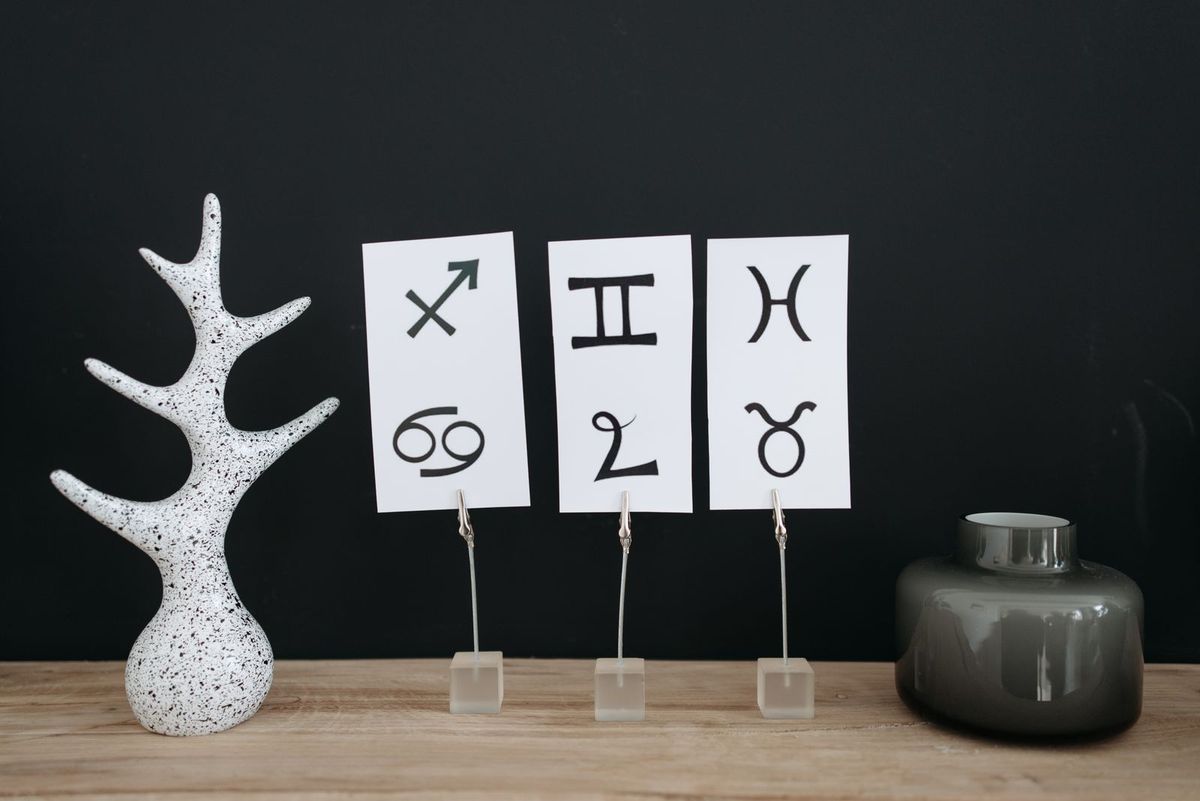
- Cards showing zodiac signs displayed on a wooden shelf — Pavel Danilyuk on Pexels (Pexels License, free to use)
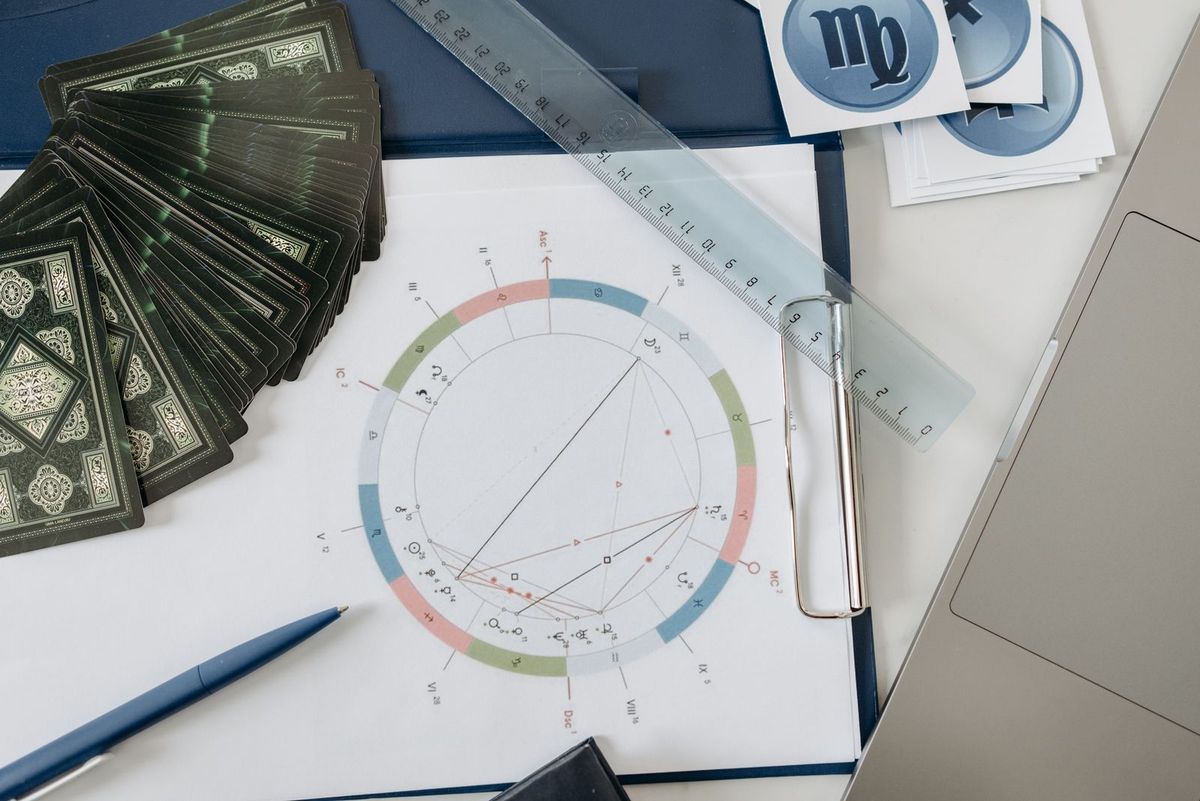
- A printed natal birth chart wheel on a desk beside tarot cards, a ruler and a pen — Pavel Danilyuk on Pexels (Pexels License, free to use)
- A star-filled night sky showing the Orion constellation — Allan Carvalho on Pexels (Pexels License, free to use)