
AI Tools for Warehouses in India: Inventory, Picking and Dispatch
Published , Updated , 21 min read
If you run a godown, a small warehouse, a distribution centre, or a fulfilment room behind an online store in India, your daily problems are rarely exotic. Stock written in a notebook does not match stock on the shelf. A picker walks to the wrong rack, picks the wrong variant, and the mistake is discovered only when the customer complains. Dispatch happens late because nobody knows which orders are ready, which are packed, and which are still waiting for stock. A warehouse tool exists to fix exactly this chain: know what you have, know where it is, pick it correctly, pack it, and dispatch it with a record. The newer tools add forecasting and automation on top, and vendors call that “AI”, but the unglamorous core — barcodes, bin locations, and a single stock number everyone trusts — is where most of the money is saved.
The direct answer is this: for a small Indian godown, start free with Vyapar or with Sortly’s free tier. Vyapar fits a business that also needs GST billing and offline working, while Sortly fits a team that mainly needs simple QR-code item tracking with photos. When orders grow past a few hundred a month and you need multiple locations, bin tracking, and batch or serial tracking, Zoho Inventory is the most practical paid step up, starting at $29 per organisation per month billed annually on the pricing page checked. Odoo Inventory is the stronger choice for a larger operation that wants deep warehouse logic such as putaway rules and wave picking, but it is paid per-user software and needs proper setup. inFlow Inventory is capable but dollar-priced from $99 a month billed annually, which makes it hard to justify for a small Indian warehouse. And if the real problem is that you do not want to run a warehouse at all, Shiprocket Fulfilment lets you store goods in its fulfilment centres and have orders picked, packed, and shipped for you, with no storage charge for the first 30 days. Every tool in this article works in India without a VPN, because all of them are ordinary web and mobile apps. Prices and free limits change often, so re-check the official pricing and help page before you pay, sign a contract, or promise a customer a dispatch deadline based on a tool’s claims.
Short answer: which tool for which warehouse
| Your situation | Start with | Why |
|---|---|---|
| One small godown, billing plus stock | Vyapar | Free to start, works offline with cloud sync, multi-godown, barcode scanning, GST invoicing |
| Simple item tracking with photos and QR codes | Sortly (free tier) | Free for up to 100 unique items, 1 user, and 2 active jobs |
| Growing orders, several locations, bins and batches | Zoho Inventory | Standard plan covers 500 orders a month, 3 users, and 2 locations |
| Large or complex warehouse, custom picking logic | Odoo Inventory | Putaway rules, FIFO/FEFO/LIFO removal, batch, cluster, and wave picking |
| Product business needing pick, pack, and ship in one system | inFlow Inventory | Real-time multi-location stock, barcode generation, 95+ integrations |
| No warehouse of your own, online orders to fulfil | Shiprocket Fulfilment | Stores, picks, packs, and ships for you; no storage fee for the first 30 days |
A note on the word “AI” in warehouse software
Be sceptical about the label. Vendors use “AI” to mean very different things, and sources disagree about what counts. In some tools it means demand forecasting: looking at past sales and suggesting how much stock to reorder. In others it means a chatbot that answers questions about a report, which is what inFlow’s AI Report Assistant does. In still others it means nothing more than barcode scanning plus automatic rules, such as sending a picker to the nearest rack first. None of these replaces a physical stock count, and none of them fixes a warehouse where items have no fixed location. Before paying for an “AI” feature, ask the vendor one question: show me, on my own stock data, one decision this feature changes. If the answer is vague, buy the tool for its inventory features, not for its label. The sections below judge each tool on the warehouse work it actually does: receiving, putaway, picking, packing, dispatch, counting, and reporting.
1. Vyapar — the small Indian godown’s all-rounder
Vyapar is the most India-shaped tool on this list. Its warehouse pages describe exactly the problems an Indian distributor or wholesaler recognises: stock across every godown, inward and outward movement, transfers between godowns, and real-time reports from one screen. It combines barcode scanning, multi-godown tracking, GST invoicing, and low-stock alerts in a single app, and it is built to work offline with cloud sync, which matters in warehouses where Wi-Fi is patchy or where a phone is the main device.
For day-to-day work, the flow is simple. A purchase updates stock automatically. A sale or a transfer updates it again, so the number on screen is meant to match the shelf. Barcodes can be generated for items and printed on a thermal label printer, and scanning during purchase, sale, or stock updates reduces picking and billing mistakes. Location-wise reports show stock per godown, and every transfer between godowns is recorded, so there is a movement history for each item rather than a mystery when numbers differ.
The honest limits are these. Vyapar’s site says “free to start” but does not present a single permanent free tier with a fixed item limit in the pages checked, so treat the free starting point as something to confirm on its current pricing page rather than as a promised allowance. It is strongest for small and mid-sized Indian businesses that want billing and stock together; it is not a replacement for a large third-party logistics operation with wave picking and automated conveyors. If your warehouse also does GST billing, Vyapar removes the need for a second billing app, and that alone saves more daily friction than any forecasting feature. It is a good first tool for a trader, distributor, or manufacturer moving from notebooks and spreadsheets to a system.
2. Sortly — simple visual tracking with a genuinely free tier
Sortly is the easiest tool here to understand. Every item gets a photo, a QR code, and a quantity, and staff scan codes with a phone to record what moved. Its free plan is stated plainly on its pricing page: $0 a month, 100 unique items, 1 user licence, and 2 active jobs. Quantities of one item do not count against the unique-item limit, which is a useful detail: 100 different products with hundreds of units each still fit. The paid Advanced plan is listed at $24 a month billed yearly, with 500 unique items, 2 users, and unlimited QR code label creation.
Sortly suits a small store-room, a repair workshop, a clinic store, or a tiny godown where the main need is “what do we have, where is it, and what went out for which job”. Jobs are its way of linking items to projects, work orders, or tickets, so a team can see what was issued to a job and what came back. It is less suited to high-volume order dispatch: it does not present itself as a full order-management and multi-channel fulfilment system in the way Zoho or Shiprocket do, and a warehouse shipping hundreds of online orders a day will outgrow it quickly.
The free tier’s real constraint is the single user. The moment two people need to update stock at the same time — one receiving goods at the gate, one picking inside — the free plan stops being practical and the paid plan becomes the real price. Even so, for testing whether barcode discipline helps your team at all, Sortly’s free tier is the cheapest honest experiment on this list, because the limit is published and there is no card-first trial confusion.
3. Zoho Inventory — the practical paid step up
Zoho Inventory is the tool most growing Indian product businesses land on, and its pricing page is unusually specific. The Standard plan is $29 per organisation per month billed annually, covering 500 orders a month, 3 users, and 2 locations, with composite items, dropshipment, backordering, and a customer portal. The Premium plan is $79 per organisation per month billed annually, covering 3,000 orders a month, 5 users, 4 locations, and 500 bins per location, adding barcode generation, stock counting, profit margin, serial number tracking, batch tracking, and a vendor portal. Higher plans extend the same pattern to 7,500 and 15,000 orders a month.
Those numbers matter because they map directly onto warehouse work. Bins mean a picker is sent to a named location rather than a vague shelf. Batch tracking matters for food, pharma, and chemicals, where an expiry or a recall has to be traced to a specific lot. Serial tracking matters for electronics and appliances, where each unit is individually identifiable. Backordering and dropshipment matter for sellers who do not want to lose a sale just because one location is out of stock. Zoho’s plans are offered as a free trial rather than a permanent free plan on the pricing page checked, so budget for the paid plan from the start and use the trial to prove the workflow, not to run the business indefinitely.
One caution: the pricing page checked lists prices in US dollars and notes that prices exclude local taxes, so an Indian buyer should check the India pricing page and the final invoice including GST before budgeting. Zoho is an Indian company with deep local presence, but the dollar figure on one regional page is not a promise about what appears on your bill. Confirm the currency, the tax treatment, and the order limit for your actual plan before promising dispatch timelines that depend on it.
4. Odoo Inventory — deep warehouse logic for larger operations
Odoo Inventory is the most warehouse-serious software on this list. Its feature pages describe storage locations for shelves, aisles, cold rooms, and pallet racks; putaway rules that route a product to its ideal location based on capacity and picking accessibility; and removal strategies including FIFO, FEFO, nearest available zone, and LIFO. Picking can be single, batch, cluster, or wave, which is the language of a real warehouse: batch picking groups many orders into one trip, cluster picking lets one picker handle several orders at once, and wave picking releases work in planned waves so dispatch deadlines are met in order.
It also covers the unglamorous operations that decide whether a warehouse stays accurate: receipts with unit-of-measure conversion, so goods bought in tonnes and sold in kilograms convert automatically; returns with routes for condition assessment, refurbishing, restocking, or disposal; package splitting for breaking bulk shipments into standard packages; scrap recording with reasons and costs; and recurring cycle counts on vital locations, products, or lots. Its barcode app is described as working offline, which addresses the dead Wi-Fi zones that exist in large concrete warehouses.
The trade-off is setup effort and price. Odoo is sold as paid per-user plans covering all its apps, and its pricing page lists Standard and Custom tiers rather than a free warehouse plan, so a small godown should not adopt it expecting a free ride. It also rewards a business that will invest time in defining locations, routes, and rules; a team that wants to start scanning in an afternoon will find Vyapar or Sortly faster. Choose Odoo when your warehouse has multiple zones, cold storage, batch or expiry rules, or a picking team large enough that walking routes and wave planning actually change labour cost. For that scale, its depth is the point, and no simpler tool on this list matches it.
5. inFlow Inventory — strong pick, pack, and ship, at dollar prices
inFlow Inventory positions itself as one system for inventory and orders: real-time stock across locations, pick, pack, and ship from any device, and connections to more than 95 integrations. Its pricing page lists Lite at $99 a month billed annually with 1 location and 2 team members, Core at $299, Pro at $499, and Max at $699, with add-ons for lot numbers, serial numbers, an AI Report Assistant, API access, a B2B showroom portal, and a mobile Stockroom scanning app from $39 a month. Barcode generation, custom labels, and label printing are included, and a hardware credit is offered to new customers toward scanners and portable printers.
For a product business that sells through several channels and wants one stock number feeding every sales channel, inFlow’s breadth is attractive, and its pick, pack, and ship flow is closer to a dispatch operation than Sortly’s item tracking. But the price is the honest problem for India. Even the Lite plan, at $99 a month billed annually, costs several times what a small Indian godown would pay for Vyapar or Zoho’s Standard plan, and the Stockroom mobile scanning app is a separate add-on rather than part of the base price. A business earning in rupees should convert the full annual cost, including add-ons, before falling in love with the interface. inFlow earns its place on this list for established product businesses with international sales or complex channel needs; for a single domestic godown, it is usually the wrong value choice, and this article says so plainly rather than recommending every tool equally.
6. Shiprocket Fulfilment — when you do not want a warehouse at all
Shiprocket Fulfilment answers a different question: what if the cheapest warehouse is someone else’s? Its fulfilment service stores your inventory at its fulfilment centres, and its platform covers order management, inventory management, and fulfilment, with integrations for channels such as Amazon, WooCommerce, and Shopify. Orders are picked, packed, and shipped from the centre closest to the buyer, which is how it offers faster delivery at lower freight cost, and multiple pickups a day reduce weight-discrepancy problems that small sellers know well.
The pricing picture is usage-based rather than a flat subscription. Its fulfilment pricing page shows a calculator: for the example of 500 monthly orders, it lists an inbound cost of ₹3,000, an outbound cost of ₹6,000, and a packaging cost of ₹2,750, working out to about ₹24 per order in that example, with a choice of corrugated box or polybag and bubble wrap as an extra. There is no storage cost for the first 30 days from the day inventory arrives, after which storage charges apply to stock left behind, and return-to-origin and removal of goods carry additional costs. That structure rewards sellers whose stock turns over quickly and punishes slow-moving stock left sitting in a centre, which is exactly the calculation a seller should do before sending a full container.
Shiprocket Fulfilment is not a software tool you install in your own godown; it is an outsourcing decision. If you run your own warehouse, compare its per-order cost against your rent, labour, packaging, and shipping for the same volume. If you sell online from home or a small office, it can remove the entire picking and dispatch burden, and the 30-day free storage window gives a low-risk way to test it with fast-moving products. Either way, get a written quote for your actual weight slabs, packaging choice, and return rate before committing, because the calculator example is an illustration, not a quote.
Using these tools in India: receiving, picking, and dispatch
A tool only helps if the physical routine changes with it. Start with receiving: every inward delivery should be scanned or entered against a purchase or transfer on the same day it arrives, because stock entered a week late creates a week of wrong decisions. Next, give every product a fixed home — a bin, shelf, or godown zone — and print the label. Pickers should never hunt; the pick list should name the location, the quantity, and the batch or serial where relevant. Zoho’s bins, Odoo’s putaway rules, and Vyapar’s godown locations all serve this one idea, and a small godown can implement it with Sortly’s QR codes just as well as with an expensive system.
Picking method should match order volume. Single-order picking suits a handful of daily orders. Batch picking suits dozens of small online orders sharing the same products. Wave picking suits a dispatch deadline, such as a courier pickup at 5 pm, where all orders for that vehicle must be ready together. If your tool cannot produce a pick list grouped the way your team actually walks, the team will ignore the tool, so test the pick list on a real busy day before paying for a year.
Dispatch is where records protect you. A packed order should be scanned out, linked to a courier or vehicle, and marked dispatched in the same system that holds the stock, so a customer query can be answered from one screen. Low-stock alerts should be set for fast movers, not for everything: alerting on every item trains staff to ignore alerts. Count on a cycle: count one zone or one fast-moving category every week rather than shutting the warehouse for a full count once a year. Every tool here supports some form of counting — Zoho’s stock counting, Odoo’s cycle counting, Vyapar’s stock reports — and the discipline matters more than the brand.
India-specific details deserve attention. Offline working matters where connectivity drops, so Vyapar’s offline-plus-sync design and Odoo’s offline barcode claim are worth testing in your actual building, not just reading about. GST invoicing matters if the same system raises bills, which is where Vyapar’s combined billing and stock is a genuine advantage. Courier integration matters for online sellers, which is where Shiprocket’s channel integrations and Zoho’s shipping workflows save manual copying. Language and staff training matter most of all: a tool your pickers cannot read on a phone screen will fail no matter how good its forecasting sounds in a demo. Run the trial with the actual picker, not just the owner.
If you also sell online, the companion guides on AI tools for online sellers in India and AI tools for delivery businesses in India cover the storefront and last-mile side of the same chain. If you manufacture what you store, AI tools for small manufacturers in India covers production-side planning, and exporters moving goods across borders should also read AI tools for exporters in India.
What to avoid
Do not buy the most expensive tool first. A warehouse with 200 products and one picker does not need wave picking, and paying for Odoo or inFlow before the basics work is how software budgets are wasted. Do not run two stock numbers: if sales happen in one app and stock lives in another without a live connection, the two will disagree, and staff will trust neither. Do not skip labels and locations. Software cannot fix a shelf where three products share one unlabeled pile. Do not promise dispatch deadlines from a vendor’s marketing page; test picking and packing speed with your own products, your own box sizes, and your own courier pickup time, then promise based on that test.
Do not ignore the total cost. A dollar-priced plan, a per-user charge, a scanning-app add-on, label-printer hardware, and storage charges after a free window can double the headline price. Add them up for a full year before comparing. Do not hand over your entire catalogue and supplier pricing to a tool without checking its data export: you should be able to leave with your products, stock levels, and movement history in a usable file. And do not treat a forecast as an order. A demand forecast is a suggestion built from past sales; a festival, a supplier delay, or a viral product can break it in a week. Keep a human approving every purchase order, especially for perishable or seasonal stock.
A short general-information note: this article is general information only, not professional tax, legal, or logistics advice. GST treatment, warehousing contracts, food and drug storage rules, and courier liability terms vary by product and state, so check the official government, tax, and carrier sources, or a qualified professional, before acting on anything here.
Frequently asked questions
Which is the best free warehouse tool for a small business in India?
For most small Indian businesses, Vyapar’s free start or Sortly’s free tier is the best free beginning. Choose Vyapar if you also need GST billing and offline working across godowns; choose Sortly if you want simple photo-and-QR item tracking for up to 100 unique items with one user. Both have limits, so confirm the current free terms on their official pages before relying on them.
Can a small godown manage without any software?
Yes, for a very small stock list, a notebook or spreadsheet can work — but the failure mode is familiar: two people update different copies, a sale is forgotten, and the shelf disagrees with the book. Software earns its keep the moment more than one person touches stock, or the moment dispatch mistakes start costing refunds and return shipping. The cheapest fix is often labels plus a free tier, not a big purchase.
What is the difference between inventory software and a warehouse management system?
Inventory software tracks what you own and how many units remain. A warehouse management system adds where each unit sits, how pickers move, how waves and batches are released, and how packing and dispatch are sequenced. Vyapar and Sortly sit closer to inventory tracking; Odoo Inventory and a full Zoho Premium setup sit closer to warehouse management. Buy the simpler one until your picking routes and dispatch waves genuinely need the deeper one.
How does barcode picking reduce mistakes?
Scanning forces a check at the moment of action: the picker scans the shelf label and the item, and the system flags a mismatch before the wrong variant goes into the box. Without scanning, a picker relies on reading a similar-looking label under time pressure, which is exactly when errors happen. Barcodes also make counting faster, because a cycle count becomes scanning a shelf rather than reading and writing every item by hand.
Is Shiprocket Fulfilment cheaper than renting my own warehouse?
It depends on turnover and order volume. For fast-moving online products, paying per order with no storage fee for the first 30 days can be cheaper than rent, staff, packaging, and courier negotiation. For slow-moving or bulky stock, storage charges after 30 days plus return and removal fees can erase the saving. Compare the written per-order quote against your real monthly rent, labour, packaging, and shipping for the same volume before deciding.
Do these tools work without a VPN in India?
Yes. All six tools are ordinary web and mobile apps available in India, and none of them requires a VPN for normal use. If a specific page or app fails to load, that is usually a network or account issue rather than a regional block; check the vendor’s status or help page before assuming the tool is unavailable.
Should I choose an Indian tool or an international one?
Choose by fit, not by flag. Indian tools such as Vyapar and Shiprocket understand GST billing, godown working, and Indian courier networks out of the box. International tools such as Odoo, inFlow, and Sortly can be stronger on deep warehouse logic or simple visual tracking, but their pricing is often in dollars and their support hours may sit in other time zones. Test support response time during your trial, because a warehouse problem at dispatch time cannot wait for the next business day in another country.
How long does it take to set up a warehouse tool?
A simple Sortly or Vyapar setup — products, photos or barcodes, locations, and opening stock — can be done in a day or two for a small godown. A Zoho Inventory setup with bins, batches, and multi-location rules takes a week or two of careful work. An Odoo Inventory setup with putaway rules, routes, and wave picking can take several weeks, especially if locations and processes are being redesigned at the same time. Do not judge setup time by the demo; judge it by how long your own opening stock count takes.
Final verdict
Start free with Vyapar or Sortly for a small godown, move to Zoho Inventory as orders grow, and consider Shiprocket Fulfilment before renting space.
Image credits:
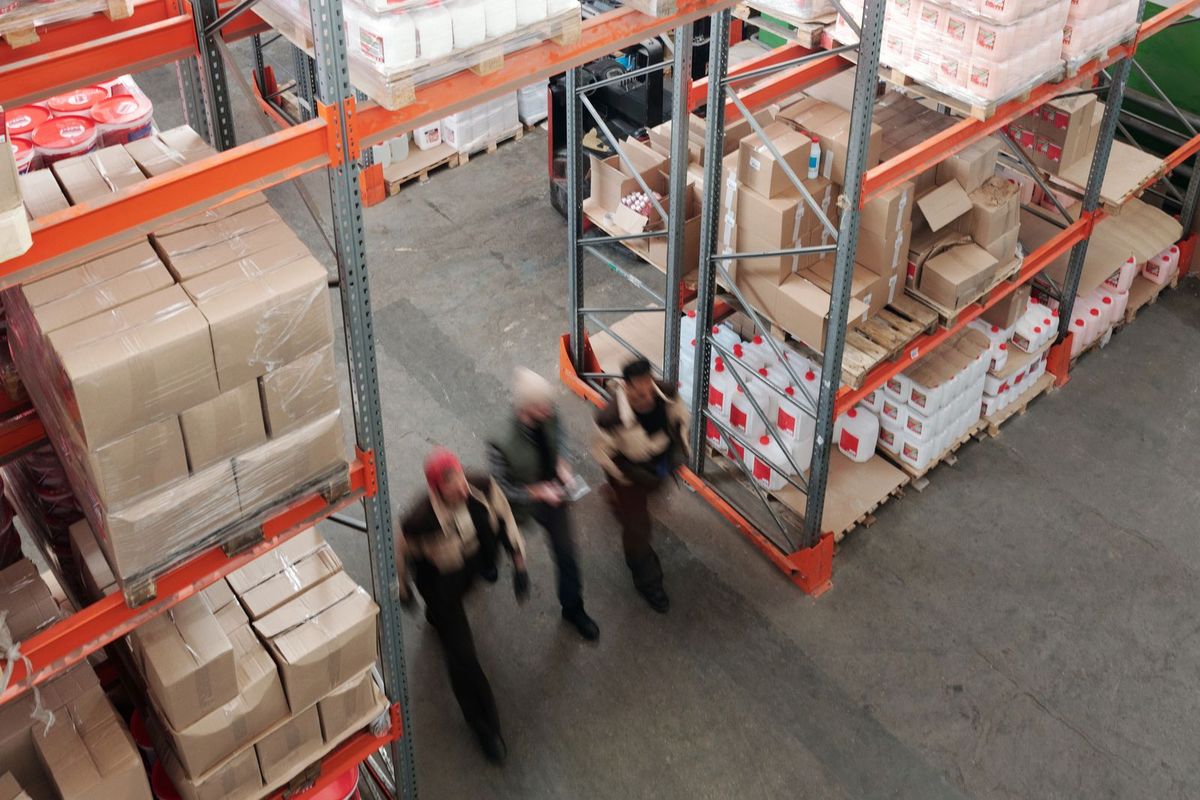
- Workers walking between tall warehouse shelves stacked with boxes — Pexels — Tiger Lily — Pexels License
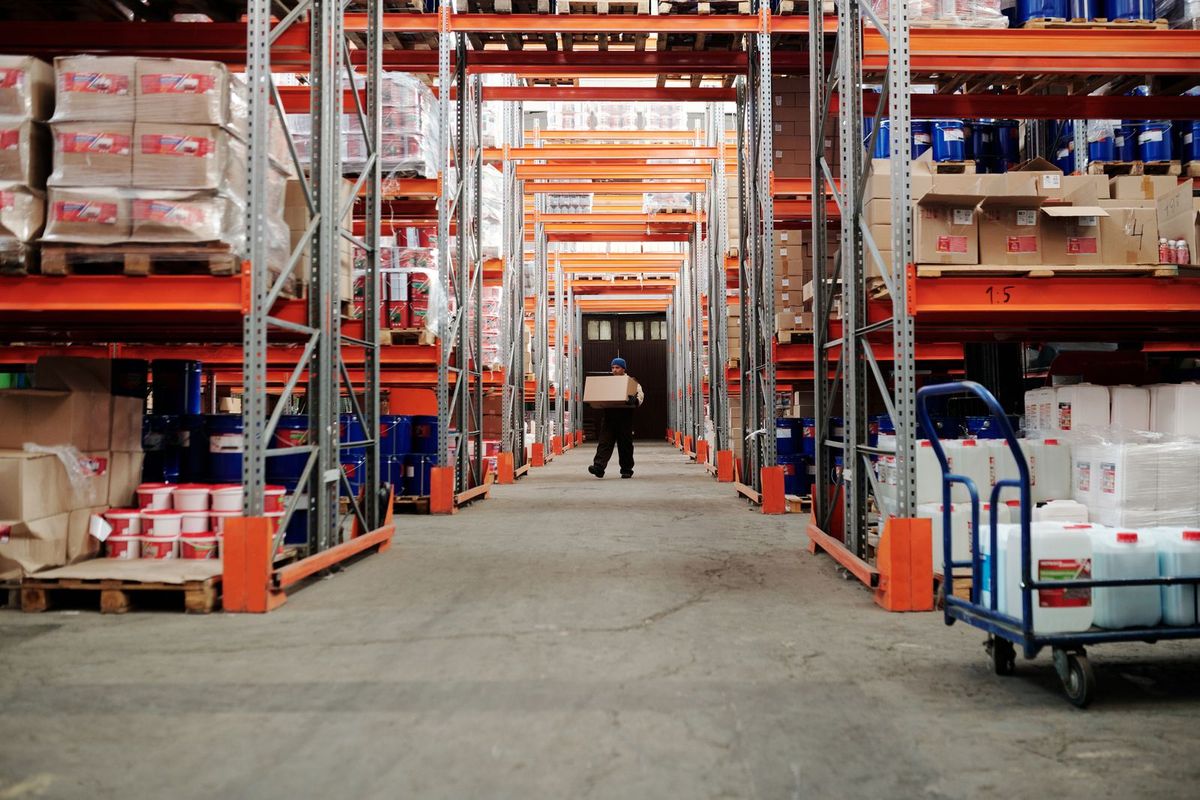
- A warehouse worker carrying a box down an aisle between stocked shelves — Pexels — Tiger Lily — Pexels License
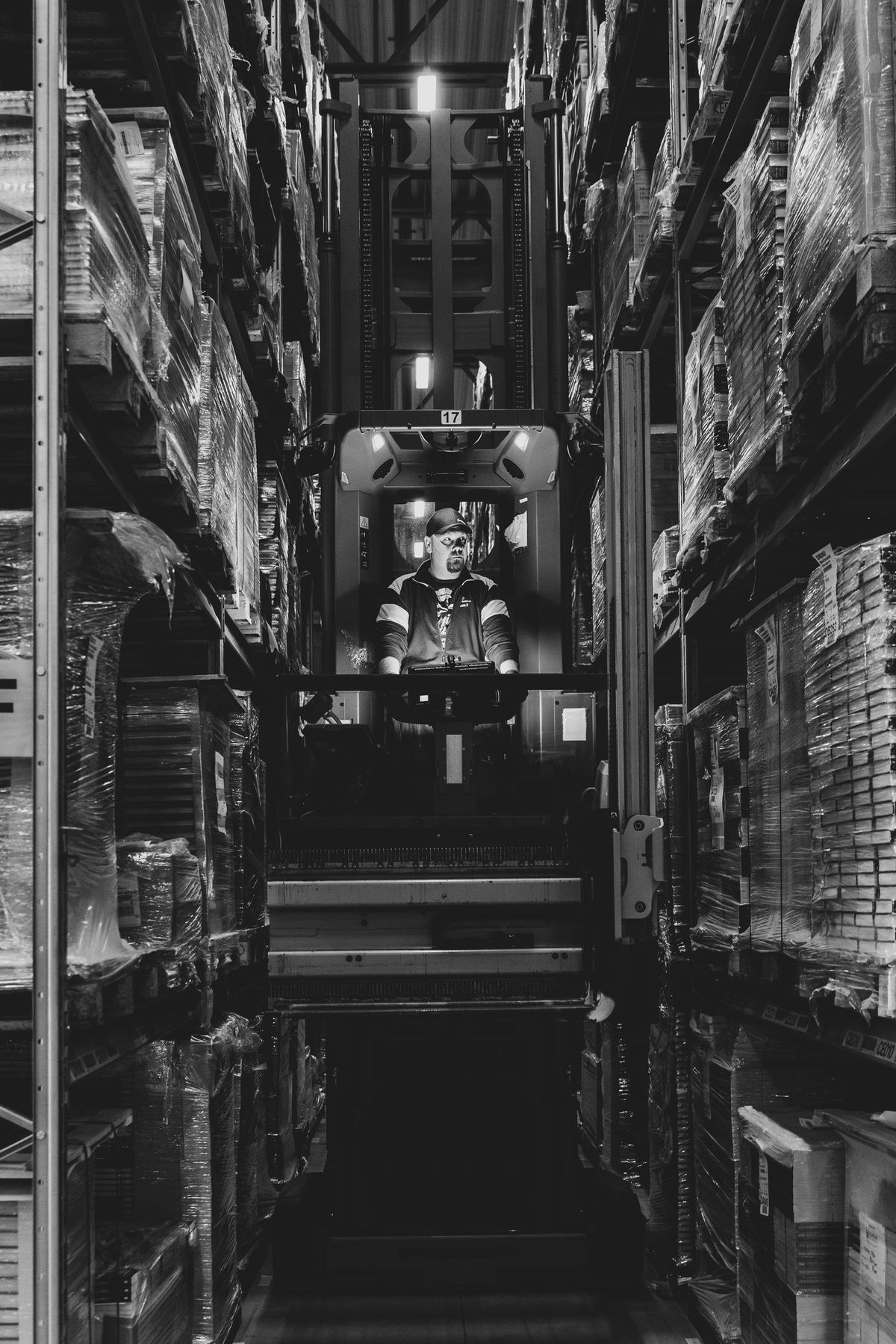
- A worker operating a forklift between tall shelves of packaged goods — Pexels — Jimmy Nilsson Masth — Pexels License